
WavePad allows you to record audio directly into the program using an accessory microphone or the internal microphone on your computer or device. To begin recording a new track, simply click the red record button, a new blank track will be created and your recording will begin automatically. The #1 video, audio, game, webcam, screen and voice recording software for PC and Mac is intuitive and user-friendly. WavePad Audio Editing Software is a full-featured professional audio and music editor. You can record and edit music, voice, and other audio recordings. WavePad is perfect for professional audio editors or just for anyone who wants to edit their own personal audio files.
- Wavepad Recording Software Download
- Wavepad Not Recording
- Wavepad Recording
- Wavepad Recording Software
- Wavepad Recording Options
- Wavepad Recording Song
How to Edit Audio Files with WavePad
You don’t have to be a professional music producer to record and edit your own music. With easy-to-use music editing software like WavePad, you can take your audio recordings to the next level. Recording and editing your songs yourself is a great way to share and preserve your musical masterpieces and anyone can do it. Whether you are recording your voice for a podcast or you are editing tracks of your band playing live music, it has never been easier to create professional-quality recordings from home.
Record Audio
If you don’t already have an audio recording to work with, don’t worry. WavePad allows you to record audio directly into the program using an accessory microphone or the internal microphone on your computer or device. To begin recording a new track, simply click the red record button, a new blank track will be created and your recording will begin automatically. You can stop your recording by clicking the square stop button, pushing the Esc key, or by clicking anywhere on the track.| Recording Audio in WavePad |
Import Audio
If you already have a pre-recorded track you would like to work with, you can easily import the track into WavePad to edit. Simply press Ctrl + O on Windows or Command + O on Mac to open it. You can also go to the main drop-down menu and select File and then Open. Import a file from your computer or external device, or you can choose to open a file directly off of a CD or data disc. You can even import files straight from the Cloud. Make sure to explore the NCH Sound Library for additional audio samples and sounds to add to your music or audio project.| Import Audio Files |
Trim Tracks
Trimming down your audio recordings or music tracks is one of the first tasks you will want to complete when you begin editing audio files. WavePad allows you to easily remove the silences from the beginning and end of your recordings. Simply select your entire track, go to the Edit tab, click Trim, and then choose the Auto-trim silence from the Start and End of the File optionfrom the drop-down menu.| Trim Out Silences in Your Tracks |
Split Tracks
You can split your recordings and files at any point you would like to in WavePad. Simply place your cursor wherever you would like to split your track, select the Split option from under the Edit tab and then choose 'Split at cursor' from the drop-down menu. This will split your audio at the position of the cursor, generating two separate tracks.| Split Tracks |
Reduce Noise
Removing background noise from your audio tracks is essential if you want to make your recording sound professional. Background sounds such as chair squeaks, footsteps, and even your own breathing, are all noises that are easily picked up by your microphone. Luckily, they are just as easily removed from your tracks. Choose the track you want to remove noise from and then select the Cleanup option in the Effects menu. From there you can choose from a variety of noise cleanup options, such as auto click/pop removal or noise reduction.| Reduce Background Noise |
Mix Audio
The Paste-Mix feature in WavePad allows you to overlay tracks to create mash-ups, voice-overs or layer recorded instruments for that full band sound. To combine the audio from two tracks into one, start by selecting one of the tracks and copying it to the clipboard. Next, select your second track and click on the Paste Mix icon in the menu under the Edit tab. When you play it back you will hear that the two pieces of audio have now been combined.| Mixing Audio Tracks |
Volume Control
Now that your song or voice recording is cut down to the good stuff, you can decide what you want to do with your volume levels. Not all microphones are created equally and so your song may end up being a lot louder or a lot quieter than you expected. Select the Levels tab to view some of the different volume control options available in WavePad. Select Normalize Audio from the effects tab to amplify audio gain across the entire track. This is a great last step to finalize your project before exporting.| WavePad Volume Control Features |
Save and Export
When you are finished editing your audio project, you will need to save it. WavePad has several easy options for saving and exporting your audio files. Under the Home tab, you can click on the Save icon and choose to burn your song to an audio or data CD, send the file in an email, upload it to the cloud, or save it as a number of audio file formats. If you plan on making additional edits to your project later, you can save all of your work as a WavePad project file to preserve quality.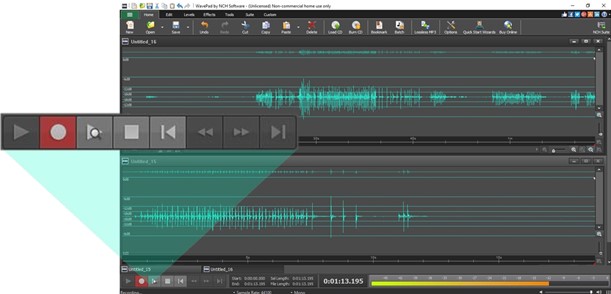
| Saving Audio Files |
WavePad Sound Editor is an audio editing program that provides several versions. Customers are wondering what it can do and how to purchase the right version. Therefore, we will tell you the introduction and review about WavePad sound editor in this post.
Part 1: What is WavePad Sound Editor?
Key features:
- 1. Cut, copy, paste, trim audio files or adjust volume on the timeline.
- 2. Include several audio effects, like amplify, normalize, equalizer, envelope, reverb, echo, etc.
- 3. Support a wide range of audio formats including MP3, WAV, VOX, M4A, and more.
- 4. Batch process audio files at the same time.
- 5. Export audio files with sample rates up to 192 KHz.
Pros
- 1. WavePad Sound Editor is able to open multiple tracks at one time.
- 2. The interface is easy to navigate.
Cons
- 1. It is not available to IOS High Sierra.
- 2. It cannot add audio to video.
How to use WavePad Sound Editor
Step 1: Download the audio wave editor and install it on your computer. Run the program and go to File > Open File.
Step 2: Choose Open an Audio File to import a sound file or hit Start a New Recording. The latter will trigger the audio recording screen and capture sound for editing later.
Tip: If you want to process multiple audio files, select Batch Process Multiple Files in the Open File dialog.
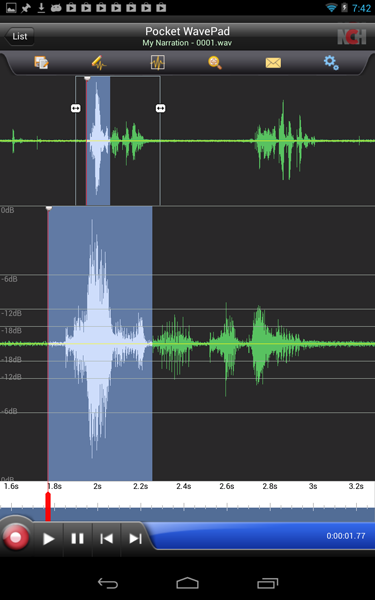
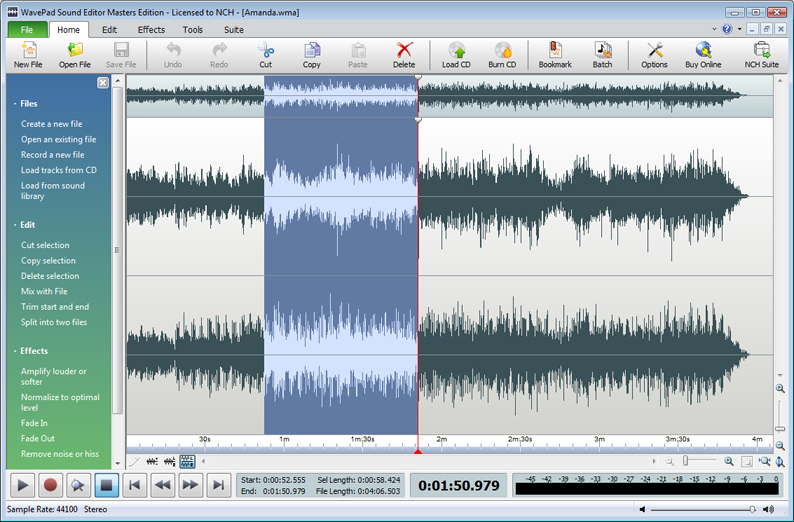
Step 3: To edit the sounds, go to the Edit menu after importing. Here you can find Delete, Split, Join, Trim, Silence and other tools. Splitting the audio into two parts, for example, place your cursor to the right place and hit Split on the top ribbon.
Step 4: If you want to add sound effects, such as Amplify, Normalize, Echo, and more, go to the Levels menu and select corresponding effect. Then adjust the custom options on the popup dialog.
Tip: The full sound effects library is only available within the WavePad Master Edition.
Step 5: When audio editing is done, click File > Save File As. Navigate to the location to save the audio file, drop the audio file name in the box next to File name, and select your favorite audio format from the Save as type drop-down menu. Click the Save button to finish it.
Frequently Ask Questions
1. How much does WavePad Sound Editor cost?
There are three versions, a free version, the Master Edition and Standard Edition. The first one can be downloaded free on the official website with limited features. The Master Edition costs $34.99 with full features including SFX Library, and the Standard Edition costs $24.99 without VST plugins support or SFX Library.
2. How can I convert cassette tapes to a digital format?
Step 1: Connect the Line Out from your cassette to the Line In of the soundcard.

Upgrade to macos high sierra. Step 2: Open WavePad Sound Editor, go to Options > Line In and click Ok.
Step 3: Hit OK and then Record. Next, play the cassette. When it is done, save the recording.
3. What file conversions does WavePad support?
Wavepad Recording Software Download
WavePad Sound Editor supports all audio formats on Windows. The Mac version does not support CAF, CDA, DSS, DVF, M4R, MID, MP2, etc.
4. Can I record my voice over a music using WavePad?
Step 1: Open WavePad Sound Editor and record your voice.

Step 2: Import both the music and the voice files. Copy the voice track and locate the music file.
Step 3: Click Paste Mix in the Edit menu.
Part 2: Top 4 alternatives to WavePad Sound Editor
WavePad Sound Editor is not the only option to record and edit audio files on computer. You can find the best alternatives below.
Top 1: AnyMP4 Video Converter Ultimate
Wavepad Not Recording
AnyMP4 Video Converter Ultimate is the multi-function media converter and editor. It can convert over 300 audio and video formats, and lets you edit the audio files as you like.

Pros
- 1. Edit music ID3 tag like cover, year, genre, artist, and other information.
- 2. Extract audio files from videos and DVDs for music listening.
- 3. Trim audio length, merge clips, and adjust audio volume.
- 4. Adjust the audio encoder, sample rate, bitrate, etc.
Cons
- 1. The free trial version will only handle limited length for the audio file.
Top 2: Audacity
Pros
- 1. Open-source and completely free of charge without ads or paid plans.
- 2. Record you voice or import a sound file for editing.
- 3. Split, cut and merge audio files on the timeline.
- 4. Export or record audio with sample rate up to 192 KHz.
- 5. Pack with effects and VST plugin.
Cons
- 1. The interface of the wave editor seems outdated.
Top 3: Wavosaur
Wavepad Recording
Pros
- 1. Support multitrack audio and batch processing.
- 2. Offer classic audio editing tools, like cut, copy, paste, paste mix, trim, delete, and undo.
- 3. Include plentiful custom options, such as mute, channel convert, change volume, etc.
- 4. Apply effects to multiple tracks at one time.
Wavepad Recording Software
Cons
Wavepad Recording Options
- 1. This alternative to WavePad Sound Editor needs some plugins, such as VST effects plug-ins.
Top 4: Adobe Audition CC
Pros
- 1. Remove sound or reduce noise from audio files smartly.
- 2. Edit the audio file in various forms, like wave, spectrum and more.
- 3. Support all audio formats.
- 4. Adjust volume of any audio files with multiple ways.
Cons
Wavepad Recording Song
- 1. It does not support MIDI.
- 2. This wave file editor is expensive.
Conclusion
This post has told you what WavePad Sound Editor is and how to use it. If you need more options, you can find three best alternatives in the second part.