


Summary: in this tutorial, you will learn how to use the SQL Server LIKE to check whether a character string matches a specified pattern.
SQL Server LIKE operator overview
On top of that, the user experience could be quite confusing for first-time users. SSMS from SQL server doesn't support inline editing nicely. The view for inline editing and view data is different, making it uncomfortable to use. All in all, DBeaver is the best tool when. DBeaver Great tool for developers to use to dive into their databases. Not so great if you are a die-hard Windows user with expectations of a SQL Management studio replacement. This is the less suited tool for people looking to just view and edit data.
The SQL Server LIKE is a logical operator that determines if a character string matches a specified pattern. A pattern may include regular characters and wildcard characters. The LIKE operator is used in the WHERE clause of the SELECT, UPDATE, and DELETE statements to filter rows based on pattern matching.
The following illustrates the syntax of the SQL Server LIKE operator:
Pattern
The pattern is a sequence of characters to search for in the column or expression. It can include the following valid wildcard characters:
- The percent wildcard (%): any string of zero or more characters.
- The underscore (_) wildcard: any single character.
- The [list of characters] wildcard: any single character within the specified set.
- The [character-character]: any single character within the specified range.
- The [^]: any single character not within a list or a range.
The wildcard characters makes the LIKE Keypad for laptop not working. operator more flexible than the equal (=) and not equal (!=) string comparison operators.
Escape character
The escape character instructs the LIKE operator to treat the wildcard characters as the regular characters. The escape character has no default value and must be evaluated to only one character.
The LIKE operator returns TRUE if the column or expression matches the specified pattern.
To negate the result of the LIKE operator, you use the NOT operator as follows:
SQL Server LIKE examples
See the following customers table from the sample database:
The % (percent) wildcard examples
The following example finds the customers whose last name starts with the letter z:
The following example returns the customers whose last name ends with the string er:
The following statement retrieves the customers whose last name starts with the letter t and ends with the letter s:
The _ (underscore) wildcard example
The underscore represents a single character. For example, the following statement returns the customers where the second character is the letter u:
The pattern _u%

- The first underscore character (
_) matches any single character. - The second letter
umatches the letter u exactly - The third character
%matches any sequence of characters
The [list of characters] wildcard example
The square brackets with a list of characters e.g., [ABC] represents a single character that must be one of the characters specified in the list.
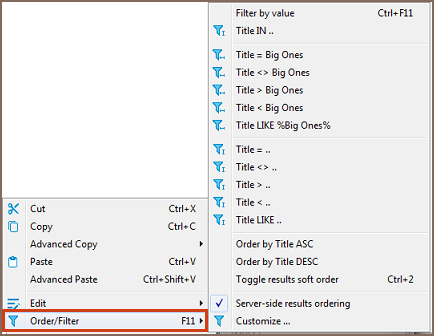
Dbeaver Sql Like
For example, the following query returns the customers where the first character in the last name is Y or Z:
The [character-character] wildcard example
The square brackets with a character range e.g., [A-C] represent a single character that must be within a specified range.
For example, the following query finds the customers where the first character in the last name is the letter in the range A through C:
The [^Character List or Range] wildcard example
The square brackets with a caret sign (^) followed by a range e.g., [^A-C] or character list e.g., [ABC] represent a single character that is not in the specified range or character list.
For example, the following query returns the customers where the first character in the last name is not the letter in the range A through X:
The NOT LIKE operator example
The following example uses the NOT LIKE operator to find customers where the first character in the first name is not the letter A:
Dbeaver Like Statements
SQL Server LIKE with ESCAPE example
First, create a new table for the demonstration:
Second, insert some rows into the sales.feedbacks table:
Third, query data from the sales.feedbacks table:
If you want to search for 30% in the comment column, you may come up with a query like this:
The query returns the comments that contain 30% and 30USD, which is not what we expected.
To solve this issue, you need to use the ESCAPE clause:
In this query the ESCAPE clause specified that the character ! is the escape character. It instructs the LIKE operator to treat the % character as a literal string instead of a wildcard. Note that without the ESCAPE clause, the query would return an empty result set.
In this tutorial, you have learned how to use the SQL Server LIKE operator to check if a character string matches a specified pattern.
The CData JDBC Driver for Parquet implements JDBC standards that enable third-party tools to interoperate, from wizards in IDEs to business intelligence tools. This article shows how to connect to Parquet data with wizards in DBeaver and browse data in the DBeaver GUI.
Create a JDBC Data Source for Parquet Data
Follow the steps below to load the driver JAR in DBeaver.
- Open the DBeaver application and, in the Databases menu, select the Driver Manager option. Click New to open the Create New Driver form.
- In the Driver Name box, enter a user-friendly name for the driver.
- To add the .jar, click Add File.
- In the create new driver dialog that appears, select the cdata.jdbc.parquet.jar file, located in the lib subfolder of the installation directory.
- Click the Find Class button and select the ParquetDriver class from the results. This will automatically fill the Class Name field at the top of the form. The class name for the driver is cdata.jdbc.parquet.ParquetDriver.
- Add jdbc:parquet: in the URL Template field.
Create a Connection to Parquet Data
Follow the steps below to add credentials and other required connection properties.
- In the Databases menu, click New Connection.
- In the Create new connection wizard that results, select the driver.
- On the next page of the wizard, click the driver properties tab.
Enter values for authentication credentials and other properties required to connect to Parquet.
Connect to your local Parquet file(s) by setting the URI connection property to the location of the Parquet file.
Built-in Connection String Designer
For assistance in constructing the JDBC URL, use the connection string designer built into the Parquet JDBC Driver. Either double-click the JAR file or execute the jar file from the command-line.
java -jar cdata.jdbc.parquet.jarFill in the connection properties and copy the connection string to the clipboard.
Below is a typical connection string:
jdbc:parquet:URI=C:folder able.parquet;
Query Parquet Data
You can now query information from the tables exposed by the connection: Right-click a Table and then click Edit Table. The data is available on the Data tab.